 Image: AI generated
维基数据的沉默
维基数据中有这样的三元组:
(tomato, instance_of, vegetable) — rank: preferred
(tomato, instance_of, fruit)     — rank: normal
谁决定了 preferred?为什么是 preferred?在什么上下文中是 preferred?
维基数据对这些问题保持沉默。编辑者做出决定,系统只是存储决定。
但番茄是蔬菜还是水果,这不是物理常数。问厨师,是蔬菜。问植物学家,是水果。问美国最高法院,是蔬菜(1893年,Nix v. Hedden)。同一个问题有三个答案,三个都没错。
知识图谱的三元组不是事实。它们是主张。
主张需要论证
要存储主张,需要结构。Toulmin 的论证模型提供了这个结构。
| 要素 | 角色 | 番茄示例 |
|---|---|---|
| Claim | 主张 | “番茄是蔬菜” |
| Ground | 直接依据 | “在烹饪分类体系中被视为蔬菜” |
| Backing | 来源/权威 | “Le Guide Culinaire (1903)” |
| Qualifier | 适用范围 | “在烹饪语境中”(置信度 0.8) |
| Rebuttal | 反驳条件 | “在植物学语境中是水果——子房结构” |
| Warrant | 连接逻辑 | “传统食材分类以烹饪用途为标准” |
不是对一个三元组强加单一的 truth value,而是将三元组提升为论证的对象。有主张,有依据,有反驳条件,有来源。而判定——不在存储时发生,而在查询时发生。
这个想法本身并不新颖。学术界已有 Dung 的抽象论证框架(1995)、ASPIC+(2010)、nanopublication 等研究探讨知识图谱上的论证。区别只有一个——我们提供的不是论文,而是可执行的代码。用 go install 安装,用 Go 函数编写规则,现在就能运行。
上下文决定真相
存储是论证结构。判定在运行时。
ctx.Set("domain", "cooking")
results, _ := g.Evaluate(ctx)
// verdict: +0.8 → vegetable

ctx.Set("domain", "botany")
results, _ = g.Evaluate(ctx)
// verdict: -0.9 → not a vegetable (fruit)
同一个图谱,同一个论证结构,同一份代码。只改变了上下文。在烹饪语境中查询得到 +0.8(蔬菜),在植物学语境中查询得到 -0.9(水果)。判定跟随上下文。
这就是与维基数据静态 rank 的根本区别。不是编辑者决定 preferred,而是查询者的上下文产生判定。
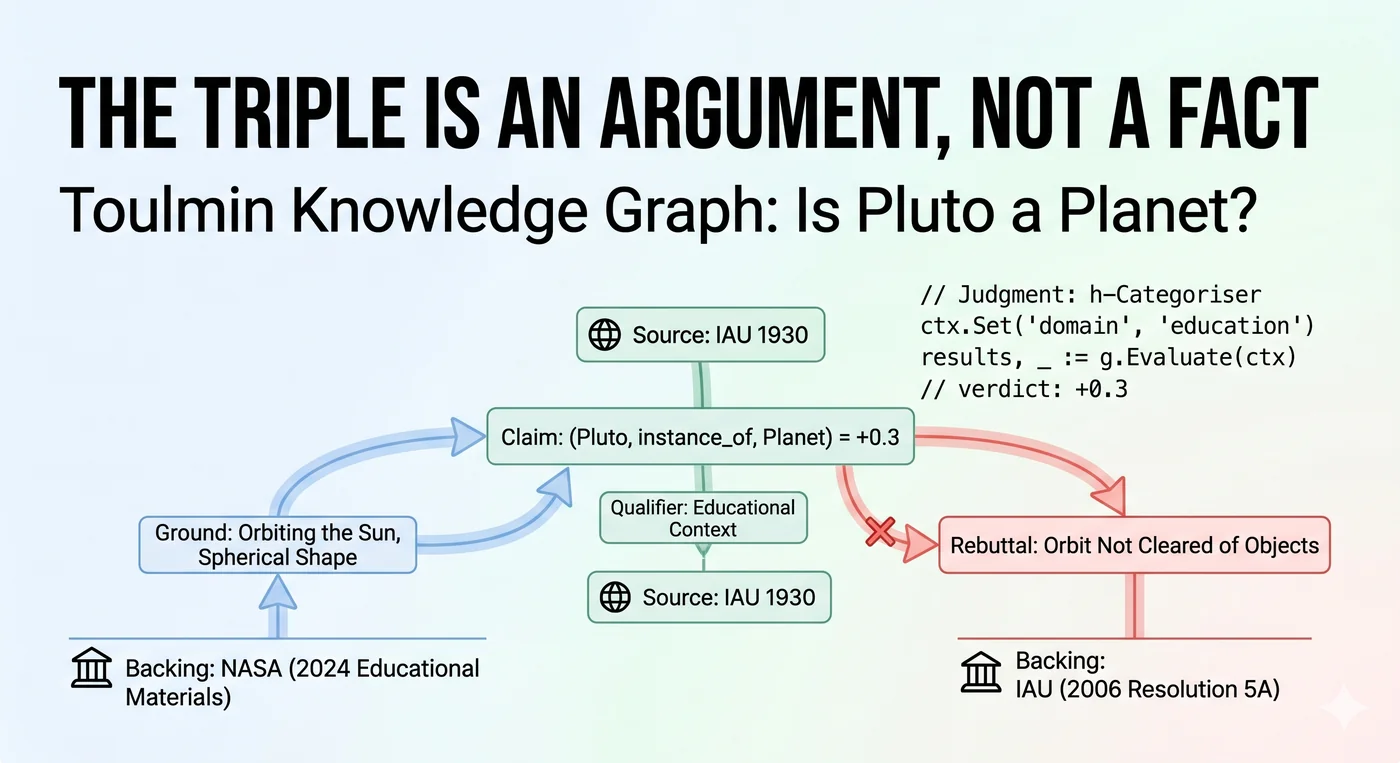
冥王星是行星吗
Triple: (Pluto, instance_of, planet)

Claim:
  Ground: "Solar orbit, spherical, sufficient mass"
  Backing: IAU 1930 classification resolution

Rebuttal:
  Ground: "Orbit-clearing criterion not met"
  Backing: IAU 2006 Resolution 5A

Exception to rebuttal:
  Ground: "Still taught as a planet in education curricula"
  Backing: NASA Education Resources 2024
ctx.Set("domain", "astronomy_formal")
// verdict: -0.8 (not a planet)

ctx.Set("domain", "education")
// verdict: +0.3 (can be treated as planet in context)
2006年之前上小学的人,冥王星就是行星。对 IAU 来说,冥王星是矮行星。两者都有依据,两者都有来源。系统要做的不是选择其一,而是两者都存储,根据上下文进行判定。
当来源被攻击时
在学术争论中,来源本身被攻击是常事。
// Claim: Drug X is effective
claim := g.Rule(drugXEffective).
    With(&TripleSpec{
        Ground:  "Significant effect in Phase 3 clinical trial",
        Backing: "Smith et al. (2020), NEJM",
    })

// Rebuttal: Independent replication failed
counter := g.Counter(replicationFailed).
    With(&TripleSpec{
        Ground:  "Effect not confirmed in independent replication",
        Backing: "Jones et al. (2022), Lancet",
    })
counter.Attacks(claim)

// Undercutter: conflict of interest
undercutter := g.Counter(conflictOfInterest).
    With(&TripleSpec{
        Ground:  "Smith's funding came from the pharmaceutical company",
        Backing: "Retraction Watch (2023)",
    })
undercutter.Attacks(claim)
Smith 的论文发表在 NEJM 上。权威来源。但当研究经费来源被揭露,基于该论文的所有主张都会被削弱。counter 正面反驳主张,undercutter 则削弱主张的依据本身。两者都攻击主张,但方式不同。h-Categoriser 综合这些攻击的强度,计算最终 verdict。
真相以光速消逝,只有主张留存。系统管理的是主张,而不是宣告真相。
所有三元组都需要论证吗
不是。
(water, chemical_formula, H2O)   — Settled. No argumentation needed.
(tomato, instance_of, ?)         — Contested. Attach argumentation.
(Pluto, instance_of, ?)          — Contested. Attach argumentation.
(Jerusalem, capital_of, ?)       — Contested. Attach argumentation.
标准很简单:如果同一 subject + predicate 存在多个 object,或 rank 有分歧,或 reference 相互冲突——就是争议性三元组。其余的保持普通三元组即可。
给水的化学式附加论证是浪费。对耶路撒冷的首都地位不附加论证是谎言。
判定引擎:h-Categoriser
论证图谱的判定由 Amgoud 的 h-Categoriser 执行。它为每个节点计算 [-1, +1] 区间的可接受度,攻击者的可接受度越高,被攻击者的可接受度就越低。递归迭代直到收敛。
性能:即使 10 万个争议性三元组各自拥有论证图谱,查询时只需 evaluate 该三元组的图谱。与整个知识图谱的规模无关。
Triple lookup:        milliseconds (existing index)
Argumentation eval:   milliseconds (h-Categoriser)
Verdict trace:        milliseconds (graph traversal)
不是扩大模型,而是扩大论证。
与维基数据 rank 的对应
| Wikidata | toulmin extension |
|---|---|
| preferred rank | verdict > +0.5 (in current context) |
| normal rank | 0 < verdict ≤ +0.5 |
| deprecated rank | verdict ≤ 0 |
| reference | Backing |
| qualifier | Qualifier + context function conditions |
区别:维基数据的 rank 是静态的,由编辑者决定。toulmin 的 verdict 是动态的,由上下文和论证结构决定。
更大的图景
这个系统不依赖于特定领域。
AI Prefrontal Cortex (feature selection):
  triple = (feature, should_include_in, app_type)
  context = current project's app tags
  verdict = should this feature be included?

Knowledge graph general:
  triple = (subject, predicate, object)
  context = querier's domain/perspective
  verdict = is this triple true in current context?
同一个引擎。同一个结构。不同的领域。规则是 Go 函数,例外是 defeats 图谱,判定是 h-Categoriser。没有 DSL。
为什么需要这个
LLM 将知识融入权重。提问就有答案。但那个答案在什么上下文中为真、基于什么来源、是否存在反驳——无法从结构上追踪。幻觉源于这种结构的缺失。
这个系统不能阻止所有幻觉。LLM 生成开放式输出,不可能预先注册所有可能的主张。但对于已经在论证图谱中注册的主张,可以将 LLM 生成的答案与之对照,评估可信度。“这个主张的 Backing 是什么。有没有攻击该 Backing 的 Counter。当前上下文中 verdict 是正数吗。”
这不是通用真相判定器。而是在积累的论证之上运作的可信度评估系统。
不是存储事实的系统,而是管理主张的系统。不是宣告真相,而是追踪判定。这就是知识图谱的下一步。
Related
- toulmin — Go Rule Engine — 基于 Toulmin 论证模型的规则引擎。本文背后的判定引擎。
- Ratchet Pattern — 确定性验证与棘轮锁定。
Code: github.com/park-jun-woo/toulmin
go install github.com/park-jun-woo/toulmin@latest
The code examples in this article represent a design vision based on the toulmin library’s current API. The knowledge graph extension (TripleSpec, context-based evaluation) is under active development. The core judgment engine (h-Categoriser, defeats graph, Rule/Counter) works today.
References
- Toulmin, S. (1958). The Uses of Argument. Cambridge University Press.
- Dung, P.M. (1995). “On the Acceptability of Arguments and its Fundamental Role in Nonmonotonic Reasoning, Logic Programming and n-Person Games.” Artificial Intelligence, 77(2), 321–357.
- Amgoud, L. & Ben-Naim, J. (2013). “Ranking-based semantics for argumentation frameworks.” SUM 2013, LNCS 8078, 134–147.
- Modgil, S. & Prakken, H. (2014). “The ASPIC+ framework for structured argumentation: a tutorial.” Argument & Computation, 5(1), 31–62.
- Groth, P. et al. (2010). “Anatomy of a Nanopublication.” Information Services & Use, 30(1-2), 51–56.
- Nix v. Hedden, 149 U.S. 304 (1893). United States Supreme Court.
变更历史
- 2026-05-22: 初版