Reins
What Is a 'Turn' in reins?
An anatomy of the turn, the smallest unit of execution in reins. What is not recorded is not a turn — from this one definition, driver independence, restart resilience, and auditability all follow. Compared against the June 2026 Loop Engineering discourse, we see how the turn converts those recommendations into structure.
abloq — A Blog an Agent Operates, a Machine Locks the Verification
Hand a blog to an agent and the articles come out. The problem is you can't trust them — it fabricates sources, bumps the lastmod of an article it never touched, and edits files no one asked it to. If a human has to inspect every line, there was no point delegating. abloq's answer is a division of labor: generation is probabilistic, verification is deterministic. The only thing a human writes is a single insight specification (insight.yaml); authoring, translation, refresh, and evidence work are carried out by agents as quests; and quality is guaranteed by a deterministic gate derived from a single blog.yaml. A locked PASS is irreversible — the agent may be disposable, but progress accumulates.
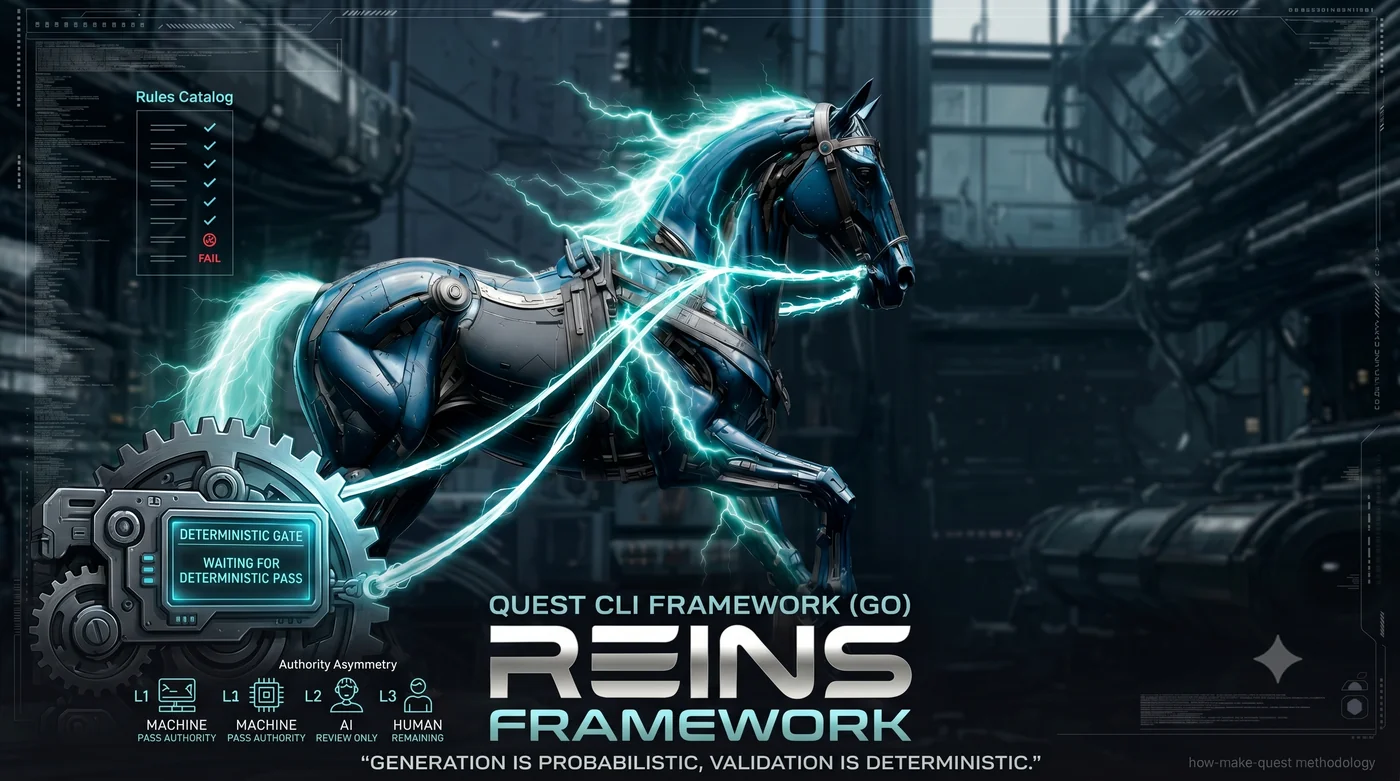
reins — Keep Only the Domain in a Quest CLI; Make the Ratchet a Framework
how-make-quest taught you to build a quest CLI with your bare hands. But build a second CLI and you write the same ratchet, the same scan/next/submit, the same tallying all over again. reins pulls that invariant out into a framework — reins supplies the ratchet, the command skeleton, the tallying, and export; you implement only your domain's gate (the four methods of gate.Definition). The gate is a catalog of cheese-defense rules, and the toulmin defeat graph hands the agent a strategy guide for 'why you lost and what to change to win.'