Fact Engineering
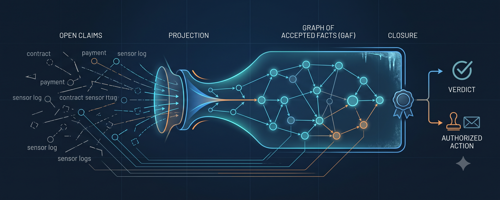
From Claims to a Graph of Accepted Facts
Before a machine can judge the real world deterministically, it must explicitly close that world: evaluate open Claims, project Accepted Facts into a traceable graph, freeze the boundary, and preserve a path to appeal.
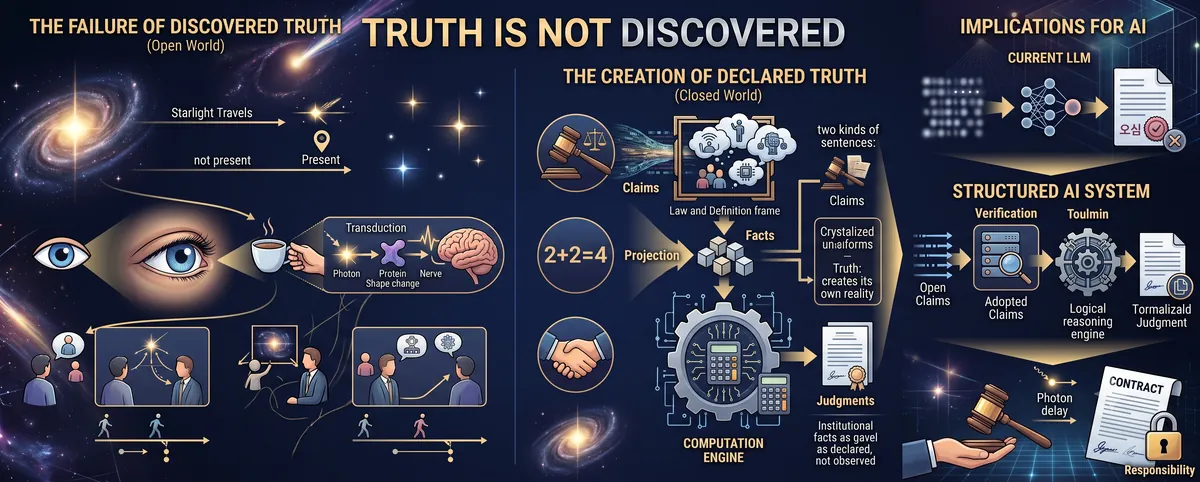
Truth Is Not Discovered
In the open world there is no truth to discover — every observation is bound by the speed of light and never reaches the event itself. But in worlds closed by declaration — fiction, mathematics, law — truth exists. A trial is the process of projecting reality into a legal world, and a verdict is a computation performed upon it. What LLMs lack right now is not a bigger model, but an explicit closure procedure like the rule of law.
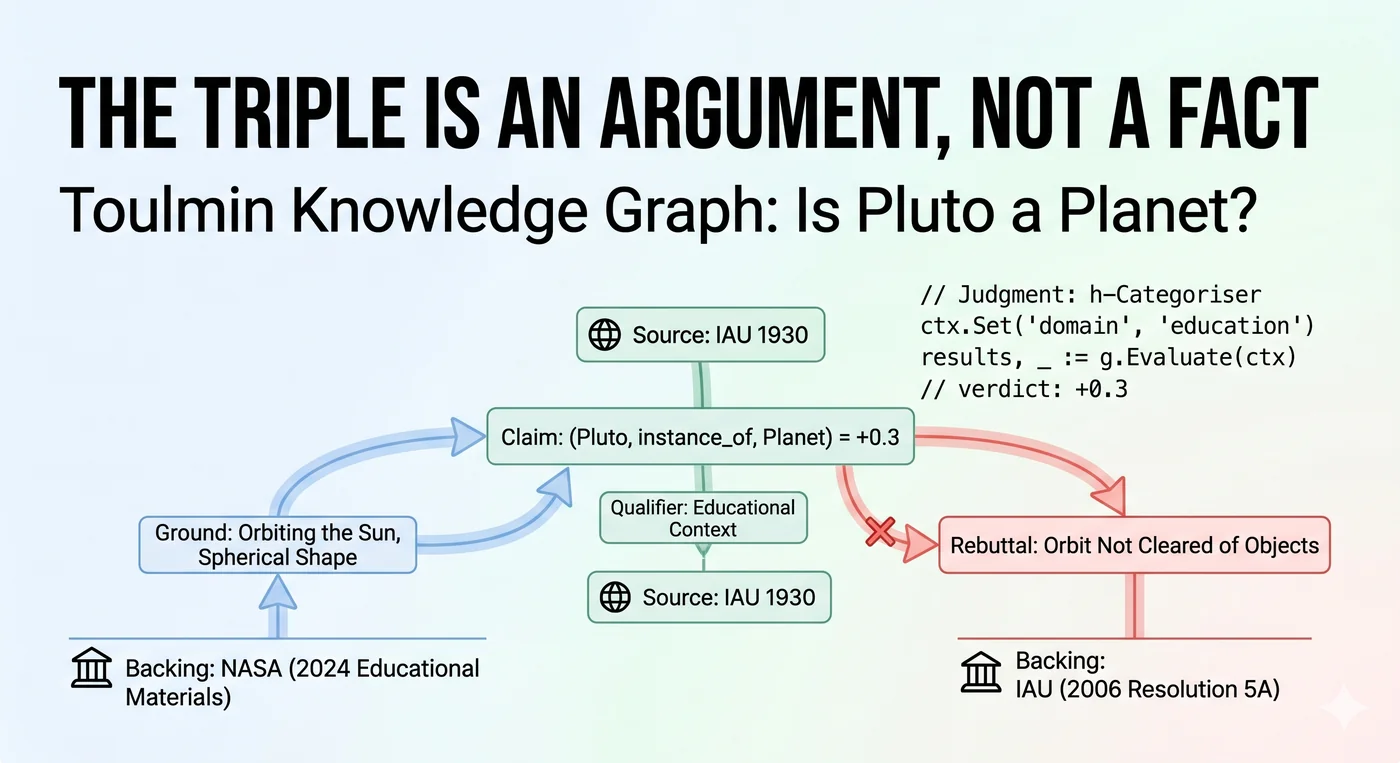
Triples Are Claims, Not Facts
Wikidata triples are not facts — they are claims. Layer Toulmin's argumentation model on top of triples, and you get a dynamic knowledge graph where verdicts change with context. Storage is argumentation structure; judgment happens at runtime.
toulmin — A Rule Engine That Computes Contracts
Rule engines have treated their validation targets as facts for 60 years. toulmin treats them as claims. An implementation of Toulmin's argumentation model as a Go rule engine.