Every year, as Christmas draws near, parents find themselves wrestling with a familiar dilemma.
“Isn’t it lying to tell my child that Santa brought the presents? Won’t they feel betrayed when they find out the truth?”
Today, I want to offer a somewhat different perspective on this age-old debate. Santa Claus is not merely a “deception” – he is the most beautiful “cultural promise” and “collective narrative” that humanity created to protect childhood wonder.
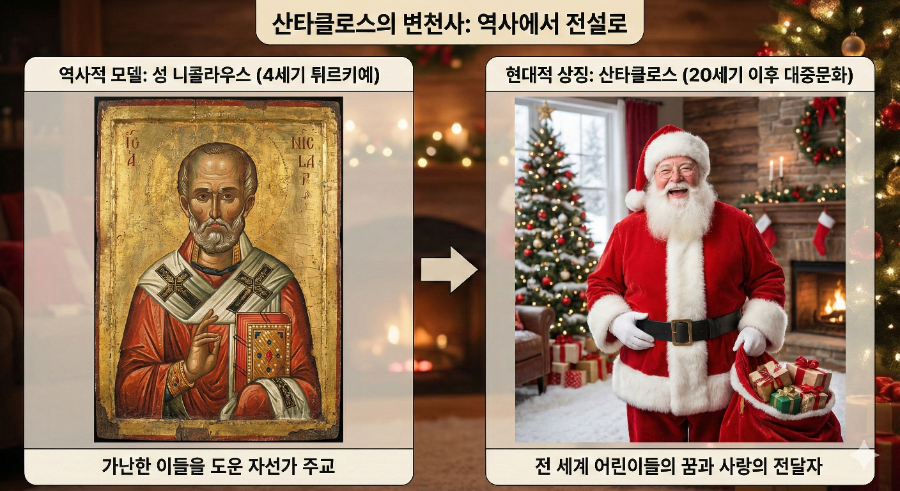
1. The Origin of the Legend: How One Person’s Goodwill Became a Spiritual Legacy
The origins of Santa trace back to St. Nicholas, a bishop in fourth-century Turkiye. He was a real person who secretly left gifts for impoverished children night after night.
After he passed away, his love for children did not vanish with him. It survived as a form of “collective memory” and “humanity’s good will,” woven into the fabric of cultures everywhere. From the Dutch “Sinterklaas” to the modern myths of a toy workshop at the North Pole and a reindeer named Rudolph, this transformation was a grand cultural project – one that humanity co-authored over centuries to preserve the value of giving.
Of course, this is a tradition rooted in Western cultures that celebrate Christmas. Around the world, there are many different winter festivals and gift-giving traditions, and Santa is simply one cultural expression among them.
2. Parents Are Santa’s Official Representatives
This is where the crucial “social contract” comes into play. Santa, as a symbolic figure, does not physically exist and therefore cannot personally deliver gifts to every child on Earth. So the communities that share this cultural tradition entered into an unspoken agreement:
Every parent becomes a “cultural representative” who carries forward Santa’s spirit of giving.
In other words, the gift a child discovers on Christmas morning was not bought by parents trying to deceive their child. It was delivered through the parents’ hands under a cultural contract made with the “spirit of giving” that Santa embodies. This is not deception – it is closer to fulfilling a cultural role within a shared community tradition.
3. Answering the Question: “But Isn’t It Still a Lie?”
At this point, many people raise an objection: “No matter how good the intention, isn’t saying something untrue as if it were true still a lie?”
That is a fair point. But think about the many cultural practices we engage in every day. We blow out birthday candles and make wishes. We shout “Echo!” from a mountaintop. We open a storybook and begin with “Once upon a time…” None of these are strictly “true,” yet we do not call them lies. We call them cultural rituals.
Santa is no different. This is not a trick designed to harm children – it is a cultural device for conveying the values of giving, anticipation, and wonder. What truly matters is helping children understand this context properly when they are old enough.
4. Santa’s Real Message: Unconditional Love
There is one point we absolutely must address here. Traditionally, the Santa story has carried a conditional message: “Only good children get presents.” But this is the greatest blind spot in the Santa tradition.
The reality is that the size of a child’s gift is determined not by how well-behaved they have been, but by their parents’ financial means. It is cruel to make a child from a poor family think, “Santa gave me less because I was bad,” when they find a modest gift under the tree.
Furthermore, the message “you must be good to be loved” teaches children a pattern of conditional love. But true love has no conditions.
That is why we need to rewrite the Santa story.
Santa gives gifts to every child. Because every child deserves to be loved simply for who they are.
Santa’s gift should be a blessing, not a reward. “I’m not giving you this because you were good – I’m giving you this because you exist.” That is the message Santa should truly deliver.
5. How to Answer “Is Santa Real?”
When the day comes that a growing child asks for the truth, we do not need to blurt out in a panic, “Actually, Santa isn’t real.” Instead, we can share the existence of this “cultural promise.”
“Santa passed away a long time ago, but his love for children lives on in the stories we tell. And parents all over the world have promised to carry on that love in his place. The gift you received is proof that our family is part of that tradition – and our message to you that you are loved unconditionally.”
When we explain it this way, instead of feeling the emptiness of having been fooled, the child feels the accomplishment of being welcomed into the adult world – a world that shares a meaningful cultural secret.
6. Conclusion: Growing Into an Agent of Love
Ultimately, the narrative of Santa Claus teaches us an important truth: the world is sustained not only by what we can see, but by invisible goodwill and unconditional love.
A child who learns the truth about Santa grows from being a “recipient of gifts” into a “bearer of love” – someone who gives unconditional joy to others. And someday, when they become parents themselves, they may make the same choice, or they may choose a different path. What matters is that their choice springs from unconditional love.
A small word of comfort to all parents out there:
The very act of choosing a gift for your child, wrapping it with excitement, and feeling that flutter of anticipation is already proof that the benevolent spirit of St. Nicholas lives on within you. You are already a wonderful Santa.
This Christmas, as you place a gift beside your child’s pillow, say this to yourself:
“Right now, I am delivering the most beautiful promise humanity has ever made – the promise that you are loved, without any conditions at all.”