Every spring, solar farms in South Korea’s Jeonnam province receive a bizarre order: “Stop generating.” The government told them to install panels, and now it tells them to throw the electricity away. It is called curtailment. In 2022, it happened 77 times — and the number has been climbing fast since. Tens of billions of won worth of electricity vanish into thin air every year.
Why not just store the surplus? Lithium-ion ESS (Energy Storage Systems) caught fire more than 30 times in South Korea between 2017 and 2019. Residents now oppose any project with “ESS” in the name. Insurance premiums have skyrocketed, and business cases have collapsed.
Here is the problem laid out plainly. Electricity is going to waste. The batteries meant to store it catch fire. Farmers are crushed by heating bills every winter. And fertilizer is almost entirely imported. Four separate crises — sitting in the same room, not talking to each other.
But what if a single battery could solve all four at once?
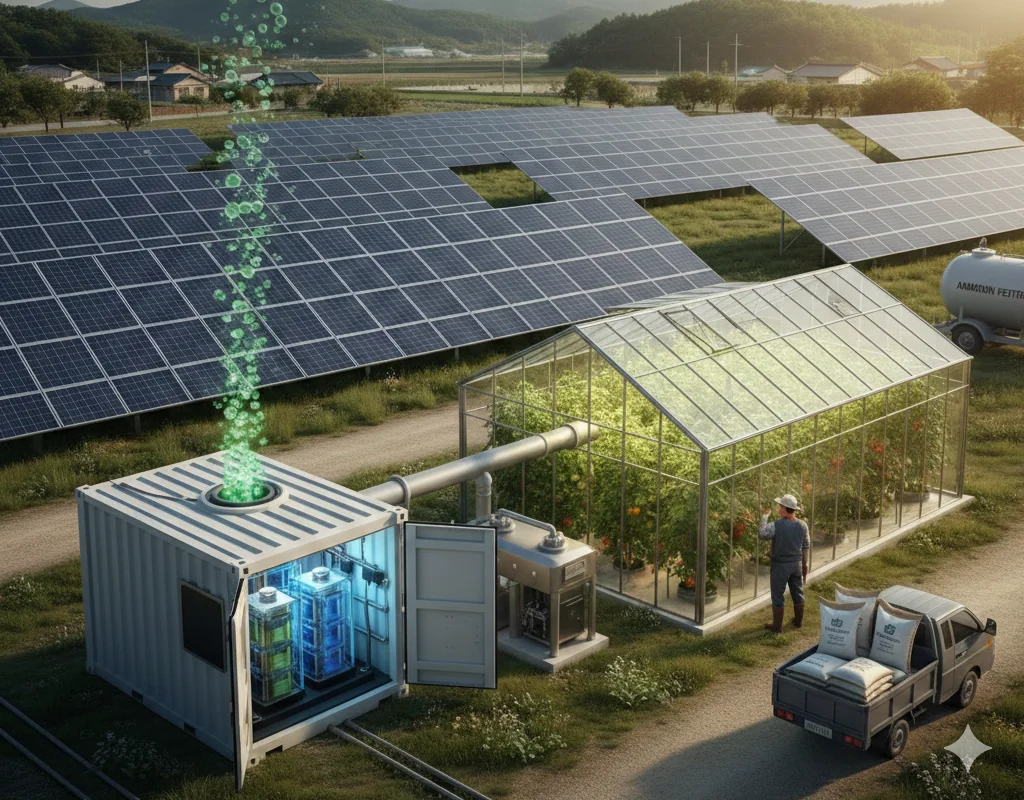
The Answer Edison Left Behind 120 Years Ago
In 1901, Thomas Edison patented a battery. The iron-nickel battery. Nickel at the cathode, iron at the anode, potassium hydroxide solution as the electrolyte. Water-based.
Line it up against lithium-ion and the contrast is stark.
| Iron-Nickel | Lithium-Ion | |
|---|---|---|
| Fire risk | Zero. Aqueous electrolyte; thermal runaway physically impossible | Organic electrolyte; thermal runaway possible |
| Lifespan | 30–50 years. Electrodes do not degrade | 10–15 years. Replacement mandatory |
| Round-trip efficiency | 60–70%. One-third of the stored energy is lost | 85–95% |
| Self-discharge | 20–30% per month. Not suited for long-term storage | 2–3% per month |
| Overcharge | Welcome. Produces hydrogen | Explosion risk |
| Over-discharge | Tolerant | Cell damage |
| BMS | Not needed. Self-regulating | Essential. Failure is catastrophic |
| 30-year total cost | Zero replacements | 2–3 replacements |
The downsides are real. Heavy, low energy density, lower round-trip efficiency than lithium-ion, and rapid self-discharge. Useless for electric vehicles. Not suitable for storing electricity beyond a month.
A closer look at self-discharge reveals something interesting. The charged iron anode reacts spontaneously with water in the electrolyte (KOH solution), generating hydrogen gas. Self-discharge is, in essence, slow electrolysis. The battery produces a trickle of hydrogen even while sitting idle. With a system to capture that hydrogen, some of the energy “lost” to self-discharge can be recovered as hydrogen. In the Battolyser configuration, the capture piping is already in place, so the added cost is minimal.
But shift your perspective and the picture changes. If the electricity is going to be wasted anyway due to curtailment? Recovering 65% beats losing 100%. There is no need to move it, so weight is irrelevant, and rural land is plentiful. And the weakness of poor long-term storage? That is solved by converting energy into ammonia. More on that below.
In February 2026, a UCLA research team announced that an iron-nickel battery built with a nanocluster process achieved multi-second charging and 12,000 cycles (over 30 years). The researchers described it as “mixing common materials and heating them.” A 120-year-old technology is still evolving.
When a Battery Becomes a Hydrogen Factory
Here is where the story takes a turn.
Researchers at Delft University of Technology in the Netherlands developed a device called the Battolyser. If you keep feeding electricity into an iron-nickel battery after it reaches 100% charge, the water inside the cell splits into hydrogen (H2) and oxygen (O2). The battery seamlessly transitions into an electrolyzer. In 2023, the first industrial-scale Battolyser installation was completed in the Netherlands.
The key is that the Battolyser integrates a battery and an electrolyzer into a single machine. Buying a separate electrolyzer doubles the equipment cost, but with a Battolyser you simply push more charging current. Switching between storage mode and hydrogen production mode happens in real time. The electrolysis efficiency in overcharge mode is comparable to alkaline electrolysis — around 60–70%. A third of the energy is lost, but the fact that it happens inside the same machine, with no extra equipment, is where the value lies.
The operating logic is straightforward. Forecast demand, reserve just enough capacity in the battery for the night’s discharge, and route all remaining surplus power directly into overcharge mode to produce hydrogen.
Daytime — Surplus solar power flows in. Charge only what is needed for tonight’s discharge; the rest goes straight into overcharge mode to produce hydrogen. Nighttime — Discharge the battery and sell the electricity to the grid. (ESS function)
This is not a three-step process of charge, discharge, then feed into a separate electrolyzer. It is a single step: overcharge produces hydrogen directly. Conversion losses are far smaller.
A lithium-ion ESS can only store electricity. A Battolyser stores electricity and produces hydrogen — in one machine, switching in real time.
From Hydrogen to Fertilizer
Once you have hydrogen, the next step opens up.
Combine hydrogen (H2) with nitrogen (N2) from the air and you get ammonia (NH3). This is the Haber-Bosch process. Invented in 1913, it is the technology that made modern agriculture possible — but it is no simple process. It requires temperatures of 400–500 °C and pressures of 150–300 atmospheres. Traditional large-scale plants produce hundreds of thousands of tons per year, far too massive to drop into a rural setting.
However, modular small-scale ammonia synthesis technology has been advancing in recent years. Electrochemical nitrogen reduction and improved catalysts are driving miniaturization and decentralization. It is still in the early stages of commercialization, and this is the most technically challenging part of the entire system. That is why ammonia synthesis is placed in Phase 2 and beyond in the roadmap.
About 80% of the world’s ammonia goes to fertilizer production — it is the backbone molecule of agriculture. Urea, ammonium nitrate, ammonium sulfate: all derived from ammonia.
South Korea imports virtually all of its fertilizer feedstock. The 2021 urea crisis — when China restricted exports and the country nearly ran out of diesel exhaust fluid — proved how fragile that dependency is.
The core outputs from a single system are four.
- Electricity — Sold to the grid at night
- Hydrogen — Feedstock for ammonia synthesis; fuel-cell fuel
- Ammonia — Fertilizer feedstock (urea, ammonium nitrate, ammonium sulfate); diesel exhaust fluid; marine fuel (Phase 2 onward)
- Heat — Battery waste heat (~60 °C) for smart-farm greenhouse heating (though the amount of heat depends on battery capacity and charge-discharge frequency, so it should be regarded as a supplementary heat source rather than standalone heating)
Oxygen (O2) is also produced as a byproduct, but utilizing it for medical or aquaculture purposes requires separate purification, compression, and transport equipment — it does not automatically become revenue.
A lithium-ion ESS can do number 1. That is it.
“The electricity from my solar panels makes my fertilizer and heats my greenhouse.” Once ammonia synthesis becomes a reality, this self-sufficient cycle becomes possible.
As the Seasons Change, So Does the Role
Spring and Autumn — Generation exceeds demand. Peak curtailment season. Based on demand forecasts, reserve only the minimum capacity needed for nighttime discharge in the battery, and route all remaining surplus power into overcharge mode to produce hydrogen. Convert this hydrogen to ammonia and stockpile it in pressurized tanks. The target: zero curtailment.
Why not just store the energy in the battery? Iron-nickel batteries self-discharge at 20–30% per month. Electricity stored in spring cannot be recovered in winter. Ammonia, on the other hand, can be stored as a liquid at room temperature in pressurized tanks (8–10 atm) with virtually zero loss — the same approach used for LPG. Short-term storage in the battery, long-term storage as ammonia. This is the core design principle of the system.
Summer — Cooling-demand peaks. The 4–6 hour gap between peak solar generation (1–3 PM) and peak air conditioning demand (5–8 PM) makes this the season where the ESS’s natural role — peak shifting — works best. Self-discharge losses over just a few hours are negligible. Maximize electricity sales revenue through peak shifting, while also switching to overcharge mode during daytime hours when wholesale prices (SMP) are at their lowest to produce hydrogen.
Winter — Sunlight is scarce. The ammonia stockpiled in spring is burned as fuel or reformed and fed into fuel cells. Battery waste heat and hydrogen boilers keep smart-farm greenhouses warm around the clock.
Electricity wasted in spring becomes heating in winter. Energy, shifted across seasons.
The Money
It Starts with Raw Materials
The long-term competitiveness of a battery hinges on raw materials.
| Iron-Nickel | Lithium-Ion (NMC) | Lithium-Ion (LFP) | |
|---|---|---|---|
| Key raw materials | Iron, Nickel, KOH | Lithium, Nickel, Cobalt, Manganese | Lithium, Iron, Phosphate |
| Raw material cost per kWh | $15–30 | $50–80 | $30–50 |
| Price volatility | Low. Iron is the most abundant metal | High. Lithium prices swung 8x | Medium. Lithium-dependent |
| Supply chain risk | Low. Globally distributed | High. 70% of cobalt from Congo | Medium |
Lithium broke $80,000 per ton in 2022 before crashing to the $10,000s in 2024. The raw material price itself is a risk. Iron runs $100–150 per ton — the most abundant metal on Earth.
That said, raw material cost and finished product price are different things. Lithium-ion has decades of mass-production infrastructure driving finished cell costs down to $100–150/kWh. Iron-nickel, still in small-scale production, sits at $200–400/kWh. If mass production materializes, the raw material cost advantage should eventually be reflected in the finished product price.
30-Year Total Cost
Lithium-ion batteries need to be replaced wholesale every 10 years or so. Over 30 years, that is three rounds. Add fire-monitoring systems, insurance premiums, and BMS maintenance — the bills never stop.
Iron-nickel batteries need one electrolyte top-up over their lifetime. Zero replacements. No fire-suppression equipment. No BMS. The upfront cost is 1.2 to 1.5 times higher, but the 30-year total cost flips in iron-nickel’s favor.
Farm-Level Economics (Estimates)
The figures below are estimates based on a greenhouse farm in Jeonnam (approx. 3,300 m2, annual irradiance of 1,300 kWh/kW). Actual savings will vary depending on system scale, crop type, and energy price fluctuations.
| Before | After (Estimated) | |
|---|---|---|
| Annual heating cost | $7,000–22,000 | $1,500–4,500 (70–80% reduction via waste heat + hydrogen boiler) |
| Annual fertilizer cost | $3,500–11,000 | Up to 50% reduction via on-site production (after ammonia synthesis) |
| Diesel exhaust fluid | Market price + supply uncertainty | Produced locally (after ammonia synthesis) |
ESS + hydrogen alone already yield heating cost savings; once ammonia synthesis is added, estimated savings per farm reach $7,000–18,000 per year.
Where and How to Begin
South Korea’s Jeonnam province has the country’s largest installed solar capacity. It suffers the most curtailment, and its concentration of greenhouse farms creates massive heating demand. The place where the problem is worst is where the solution works best. The technology was proven by Edison in 1901, validated at industrial scale by Delft University in 2023, and pushed to a new performance level by UCLA in 2026. What remains is scale-up.
The optimal scale-up strategy is not building a mega-plant from day one. It is stacking container-sized modular Battolysers like building blocks. When demand grows, add a module. If something fails, the loss is confined to one unit.
Phase 1 (Years 1–2): ESS + Hydrogen Demonstration Install a 1–10 MWh Battolyser ESS in Haenam or Yeongam, Jeonnam. Designate it as a regulatory sandbox zone to clear certification hurdles. At this stage, focus on ESS charge-discharge and hydrogen production. Hydrogen is sold directly or used for boiler heating. No ammonia synthesis. The key is isolating the most technically challenging component to reduce risk.
Phase 2 (Years 3–5): Ammonia Synthesis Introduction Use Phase 1 demonstration data to bring in KEPCO and the Korea District Heating Corporation. Scale to GWh-class. This is the stage where modular ammonia synthesis plants are introduced. Miniaturizing and modularizing the Haber-Bosch process is the technical crux at this phase. A domestic manufacturing consortium with steel and non-ferrous metal companies is needed.
Phase 3 (Years 5–10): Nationwide Rollout and Export Replicate the Jeonnam model across every solar-dense region nationwide. Export the integrated package — “Solar + Iron-Nickel ESS + Ammonia Plant + Smart-Farm Heating” — to Southeast Asia, Africa, and the Middle East.
Anticipated Objections and Responses
“A round-trip efficiency of 65% means you lose a third of the electricity, doesn’t it?” Yes. Compared to lithium-ion at 90%, it is worse. But the comparison is wrong. Electricity lost to curtailment has an efficiency of 0%. The choice is between 0% and 65%. Where lithium-ion can be installed, use lithium-ion. This is the alternative for places where installation is blocked by community opposition and fire risk.
“Ammonia is toxic. Isn’t it dangerous in a rural area?” Ammonia is a hazardous gas that is dangerous when inhaled. This is a fact and must not be taken lightly. However, more than 180 million tons of ammonia are already produced, transported, and stored worldwide each year. Decades of safety management protocols exist from fertilizer plants, cold storage facilities, and chemical plants. Rural modular plants must mandate sealed storage, leak detection, and emergency shutoff systems.
“The upfront investment is too large.” The initial investment for a Phase 1 demonstration (1–10 MWh) runs in the tens of billions of won. Without government subsidies and a regulatory sandbox, the private sector alone cannot shoulder it. However, considering that hundreds of billions of won in electricity are wasted annually through curtailment and trillions of won are spent on fertilizer imports, the expected return on demonstration investment is more than justified.
“So who is actually going to do this?” This is the crux. Even with technical feasibility and economic viability, nothing happens without someone to execute. Solar farmers get curtailment relief. Greenhouse farmers get lower heating bills. Residents near ESS sites lose their fire anxiety. Environmental groups welcome zero-carbon fertilizer. National security planners gain domestic fertilizer and urea supply chains. Every stakeholder benefits. What is needed is the policy decision to break ground.
A battery invented by Edison 120 years ago. Water, iron, and nickel. It does not catch fire. It lasts 30 years. Overcharge it and it gives you hydrogen. Its efficiency is lower than lithium-ion, and ammonia synthesis still has hurdles to clear.
Yet the reason this technology deserves attention is that it opens a path from wasted electricity all the way to fertilizer and heating. Electricity thrown away in spring becomes heating in winter. It is not perfect, but 65% is better than 0%. What is needed is the first demonstration.