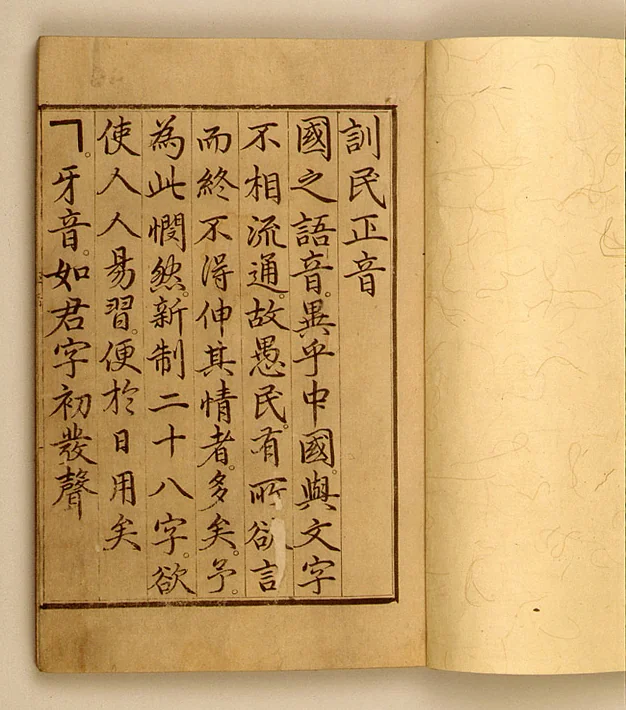
 Source: Wikipedia · Public Domain
The scale of human civilization has been determined by information technology.
Spoken Language: Birth of the Tribe
A hundred thousand years ago, spoken language appeared. Primates had maintained their bonds by grooming one another’s fur, but this method could sustain no more than 150 individuals. Language shattered that limit. One person could address many at once, and information about people never met in person could be passed along. A single utterance — “The tribe beyond that mountain is heading this way” — made cooperation among hundreds possible. Spoken language created the tribe.
Ten thousand years ago, agriculture began. Food surpluses led people to settle in one place, and settlements became villages, then cities. But cities bred problems unlike anything tribes had faced. How much grain is there? Who has paid their taxes? Whose land is this? Spoken language alone could not manage this information. Words vanish the moment they are spoken.
Five thousand years ago, someone in Mesopotamia pressed wedge-shaped marks into a wet clay tablet — to record the number of sacks of grain. This was writing. Writing accomplished the one thing speech could not: it fixed information onto time. Once people could rely on records rather than memory, bureaucracy became possible, law became possible, empire became possible. Writing created the state.
The Pattern of Information Technology
A pattern emerges here.
Spoken language enabled the real-time transmission of information. And so a new scale of society appeared: the tribe. Writing enabled the temporal preservation of information. And so a new scale of society appeared: the state. A revolution in information technology produced a revolution in social scale.
We now stand at the third turning point.
The Limits of AI Thinking in Natural Language
AI has opened, for the first time in human history, an era in which a non-human entity processes information. Yet this entity thinks in human language. It receives input in natural language, reasons in natural language, outputs in natural language. Each time, it thinks from scratch and discards the result. It does not record. It does not accumulate.
This is much like a city before the invention of writing.
Tens of thousands live together in a city, yet all information exists only in human memory. Grain stocks must be counted in person every time. Tax payments depend on witnesses’ recollections. Laws exist only in the words of elders. It works. But it cannot scale. Efficiency hits a ceiling.
The Mesopotamians solved this problem with writing. They fixed speech onto clay. They turned memory into record.
AI needs the same thing.
A system that structures and records AI’s reasoning. A system in which a single act of reasoning does not vanish but accumulates. A system in which accumulated reasoning becomes the foundation for the next. A structured language, free from natural language’s ambiguity, in which source, context, and degree of confidence are made explicit.
Designing the Third Language
If spoken language arose naturally for communication between humans, writing was deliberately invented for the management of information. And now, a third language must be deliberately designed — for the management of AI’s reasoning.
If spoken language created the tribe, and writing created the state, what will this third language create?
A civilization of a scale that does not yet have a name.